Sunil Sharma Dares Omar Abdullah: ‘Resign and Seek Fresh Mandate on Statehood’ — What the BJP Challenge Means for J&K Politics
By: Javid Amin | 01 September 2026
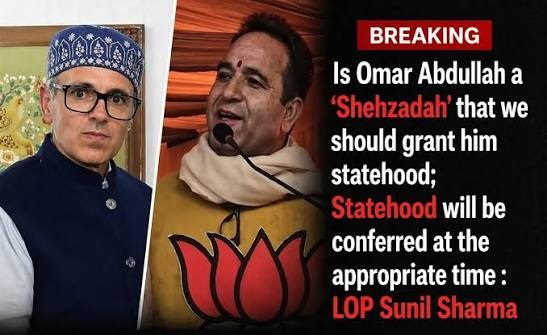
Srinagar: Jammu and Kashmir’s political battle over statehood has entered a sharper phase, with BJP Leader of Opposition Sunil Sharma challenging Chief Minister Omar Abdullah to resign and return to the electorate if restoration of statehood is truly the central issue on which his government wants a public verdict.
Sharma’s challenge came as the ruling National Conference and the BJP prepared for competing protests in Jammu and Kashmir, turning the statehood question into the centrepiece of another round of political confrontation between the government and the principal opposition party.
“If you have moral courage, ethics and values, resign and fight the elections in the name of statehood,” Sharma said while addressing reporters in Srinagar. He argued that Omar should contest a fresh election exclusively on the statehood issue and allow the people of Jammu and Kashmir to decide whether they endorse his position.
The challenge is politically provocative, but it also raises a larger question:
Can an elected government be asked to seek a fresh mandate every time it makes a major political demand after an election?
That question goes to the heart of the latest BJP-National Conference confrontation.
Sunil Sharma’s Direct Challenge to Omar Abdullah
Sharma, who is the Leader of Opposition in the Jammu and Kashmir Legislative Assembly, accused the Omar Abdullah-led government of turning statehood into a political shield against criticism of its governance record.
His argument is straightforward: if statehood is the defining issue for the government, then Omar should seek a fresh mandate specifically on that question.
The BJP leader questioned whether the National Conference actually received its 2024 electoral mandate on statehood alone. He pointed to the broader promises made by the party during the Assembly campaign and argued that voters had not been asked to elect a government exclusively on the question of restoring statehood.
Sharma also accused the government of using the statehood campaign to divert public attention from unemployment, recruitment and other governance concerns.
That accusation is now becoming a recurring BJP theme.
Earlier in 2026, Sharma had similarly accused the National Conference of using statehood to shift the political narrative away from issues such as governance and employment.
The latest challenge therefore appears less like an isolated remark and more like part of a sustained BJP strategy: force the NC to defend its record while simultaneously questioning the political basis of its statehood campaign.
Why the Challenge Has Come Now
The timing is crucial.
The National Conference has announced a peaceful protest outside BJP offices in Jammu and Srinagar, seeking accountability from the Union government over commitments relating to Jammu and Kashmir’s statehood and other issues.
The BJP, meanwhile, has announced its own protest march towards the Civil Secretariat in Srinagar, accusing the Omar Abdullah government of failing on issues including recruitment, employment and governance.
The two parties are therefore preparing parallel demonstrations, with each attempting to place responsibility for Jammu and Kashmir’s problems on the other.
Sharma’s resignation challenge fits neatly into this confrontation.
Instead of allowing the NC’s protest to remain focused on the Centre’s promise of statehood, the BJP is attempting to turn the spotlight back on Omar Abdullah:
If statehood is the mandate, why not seek that mandate again?
It is a classic opposition tactic — transform the ruling party’s strongest political issue into a test of its credibility.
Did Omar Abdullah Actually Win the 2024 Election on Statehood?
This is where the BJP’s argument becomes more complicated.
It is true that statehood was one of the National Conference’s major promises in the 2024 Assembly election.
But it was not the only one.
The NC’s manifesto included a much broader political and economic programme. It promised to strive for restoration of Article 370 and 35A, restoration of statehood, changes to the Jammu and Kashmir Reorganisation framework, employment measures, free electricity for certain consumers, welfare measures and other commitments.
The party ultimately won 42 of the 90 elected Assembly seats, while its Congress ally won six. Together, the alliance secured 48 seats, with the CPI(M) also winning one seat and supporting the broader alliance arrangement. The BJP won 29 seats.
Therefore, saying that Omar Abdullah’s government won a mandate only on statehood would oversimplify the 2024 election.
At the same time, it would be equally inaccurate to suggest that statehood was absent from the electoral mandate.
It was explicitly part of the NC’s political programme.
That distinction matters.
The NC’s Statehood Argument: ‘We Were Elected to Pursue Our Promises’
From the National Conference’s perspective, Sharma’s challenge does not necessarily undermine its position.
A government normally seeks a mandate for a complete manifesto, not one individual promise.
The NC can therefore argue that it was elected on a broad programme that included statehood and that pursuing statehood is part of the mandate it already received.
The party has also argued that restoration of statehood is not merely an NC demand but a constitutional and political commitment that should be fulfilled by the Union government.
The NC has recently framed its protest around what it describes as commitments made by the Centre in Parliament and before the Supreme Court.
This gives the dispute another dimension.
The question is no longer simply:
Does Omar have a mandate for statehood?
It is also:
Does the Union government have a political obligation to fulfil the promise of restoring statehood?
The BJP and NC are effectively answering those questions from opposite ends.
BJP’s Position: Statehood Is Coming, But on the Centre’s Terms
Interestingly, Sharma’s latest challenge does not amount to the BJP rejecting statehood altogether.
That point deserves emphasis.
In June, Sharma himself said restoration of statehood was a BJP commitment and would be fulfilled, although he said the process would be guided by the security situation and lasting peace and stability.
In February, he similarly said that statehood was coming, while declining to give a specific timeline or say that the process would necessarily follow consultation with Omar Abdullah.
So the central BJP argument is not simply:
“There will be no statehood.”
It is closer to:
“Statehood will return, but the NC cannot use the issue as a political weapon against the Centre or as an excuse for failures in governance.”
This is an important distinction in understanding the BJP’s strategy.
The Bigger Fight: Statehood or Governance?
Sharma’s latest remarks attempt to shift the political battlefield.
The NC wants the public conversation to focus on the delay in restoring statehood.
The BJP wants voters to focus on what it describes as failures of the Omar Abdullah administration.
This creates two competing political narratives.
The National Conference’s narrative
Jammu and Kashmir was promised restoration of statehood, and the Centre must honour that commitment.
The BJP’s narrative
The Omar Abdullah government already has an elected Assembly and should focus on governing rather than using statehood to distract from unemployment, recruitment and other public concerns.
Neither argument exists in isolation.
Both are designed for the electorate.
And both are likely to become more prominent as the political temperature rises.
Why Sharma’s ‘Resign and Contest’ Formula Is Politically Significant
The demand for resignation is not merely a rhetorical attack.
It is an attempt to question the political legitimacy of the government’s present campaign.
Sharma is effectively saying that if statehood has become Omar Abdullah’s overriding political priority, then the Chief Minister should put that demand directly before voters.
But there is a constitutional and political problem with that proposition.
Governments are not ordinarily required to resign simply because an opposition party disputes one component of their manifesto.
The Omar Abdullah government has a five-year Assembly term. The Election Commission of India’s current term-of-the-houses data lists the Jammu and Kashmir Assembly’s term as running from November 4, 2024, to November 3, 2029.
Unless the government loses its majority, the Chief Minister resigns voluntarily or some other constitutional circumstance triggers an early election, the normal democratic route is to govern for the duration of the Assembly.
That makes Sharma’s demand primarily a political challenge rather than an immediate constitutional necessity.
Its purpose is to put Omar on the defensive.
Article 370 Makes the Statehood Debate Even More Complicated
There is another layer beneath the latest dispute: Article 370.
The BJP has consistently separated the two issues.
Its position is that statehood can be restored but the constitutional changes of 2019 will not be reversed.
The Supreme Court’s December 2023 judgment upheld the Union government’s constitutional changes concerning Article 370 and the reorganisation of Jammu and Kashmir. The court also directed that statehood be restored at the earliest and as soon as possible.
This has produced an unusual political situation.
The BJP can support restoration of statehood while rejecting any return to the pre-August 2019 constitutional arrangement.
The National Conference, however, entered the 2024 election with a manifesto that sought restoration of both statehood and Article 370/35A.
That historical position continues to complicate the party’s present political strategy.
The NC’s immediate campaign has increasingly centred on statehood, while demands concerning Article 370 remain part of the wider political debate.
This has already triggered criticism from within the broader political camp, including Srinagar MP Aga Syed Ruhullah Mehdi, who has questioned the emphasis being placed on statehood compared with the party’s earlier constitutional demands.
The BJP’s Political Opportunity
For the BJP, the current situation offers a useful opening.
The party is in opposition in the J&K Assembly, with 29 seats, and therefore cannot form the government on its own.
Its challenge is to remain politically relevant while the National Conference controls the administration.
Statehood provides an opportunity to do exactly that.
If the BJP can portray the NC as excessively focused on constitutional demands while failing to address jobs, recruitment, electricity, administration and other everyday concerns, it can attempt to broaden its appeal beyond its traditional support base.
Sharma’s resignation challenge serves that objective.
It converts an abstract constitutional question into a question of electoral accountability.
But There Is a Risk for the BJP Too
There is another side to the political calculation.
Statehood is not an issue confined to the National Conference.
There is considerable political support across Jammu and Kashmir for restoration of full statehood, and the BJP itself has repeatedly said that statehood will eventually be restored.
Consequently, aggressively attacking the NC for raising statehood could carry a political risk if voters interpret the BJP’s criticism as opposition to the demand itself.
Sharma appears to be aware of this distinction.
His earlier statements explicitly described statehood as a BJP commitment.
The party therefore has to maintain a careful line:
Support statehood in principle, but oppose the NC’s method of demanding it.
That is a much more sophisticated political position than simply rejecting statehood.
Omar Abdullah’s Own Political Dilemma
For Omar Abdullah, the challenge comes at an uncomfortable moment.
He has to maintain pressure on the Centre without allowing the BJP to successfully portray the statehood campaign as an excuse for shortcomings in administration.
That balancing act is becoming increasingly difficult.
If Omar pushes too aggressively on statehood, the BJP can accuse him of neglecting governance.
If he softens his campaign, critics within Kashmir’s political landscape can accuse him of abandoning a central political promise.
The National Conference therefore has two audiences to satisfy:
New Delhi, where it wants statehood restored, and the electorate in Jammu and Kashmir, which expects the government to deliver on both constitutional and everyday governance issues.
That is a difficult political equation.
The Parallel Protests Could Deepen the Political Divide
The competing protests planned by the NC and BJP are another sign that the disagreement is moving beyond Assembly speeches and press conferences.
The BJP has announced a march towards the Civil Secretariat, led by party president Sat Sharma and Leader of Opposition Sunil Sharma, while the National Conference has announced protests targeting BJP offices in Srinagar and Jammu.
The symbolism is striking.
The ruling party wants to take its demand to the opposition’s political offices.
The opposition wants to take its campaign directly to the seat of government.
Both sides are attempting to demonstrate political strength.
And both are trying to make the other party answer for Jammu and Kashmir’s unresolved political questions.
What Does the People’s Mandate Actually Say?
This may be the most important question in the entire controversy.
The 2024 election produced a clear result, but it did not produce a referendum on statehood.
Voters were choosing among competing political programmes that included employment, development, welfare, constitutional issues and governance.
The NC emerged as the largest party with 42 seats, while the BJP secured 29.
There is therefore little basis for claiming that the election provided an exclusive numerical mandate for one particular issue.
But there is also little basis for claiming that the statehood demand lacks electoral legitimacy altogether.
The more accurate interpretation is that statehood formed part of the mandate on which the NC came to power.
Whether that gives Omar Abdullah the political authority to campaign for statehood throughout his term is a question of political interpretation, not something that automatically requires another election.
The Real Test May Not Be a Fresh Election
Despite Sharma’s dramatic challenge, the more meaningful test of Omar Abdullah’s political credibility may come through the next regular electoral cycle rather than an immediate resignation.
Until then, the Chief Minister’s performance will be judged through several measures:
- Whether the government can improve employment opportunities.
- Whether recruitment processes are seen as transparent.
- Whether development reaches both Jammu and Kashmir regions.
- Whether the government can deliver on its welfare commitments.
- Whether it can maintain political pressure for statehood.
- Whether it can manage its relationship with the Union government.
- Whether the National Conference can maintain unity around its post-2019 political agenda.
In other words, statehood may be one measure of political credibility, but it is not the only one.
A New Phase in Jammu & Kashmir Politics
The latest confrontation suggests that Jammu and Kashmir politics is gradually moving into a different phase.
The immediate post-2019 debate was dominated by Article 370.
Today, statehood has become the more practical and widely shared political demand, even though disagreement over Article 370 remains unresolved.
The BJP wants to draw a firm constitutional boundary: statehood can return, but the 2019 constitutional changes are not up for reversal.
The National Conference wants the Centre to act on statehood while retaining a broader political argument about Jammu and Kashmir’s constitutional rights.
And the electorate is increasingly being asked to judge both sides on a mixture of identity, constitutional status and everyday governance.
That makes the political contest considerably more complicated than a simple BJP-versus-NC confrontation.
Conclusion: Sharma’s Challenge Is About More Than Resignation
Sunil Sharma’s demand that Omar Abdullah resign and seek a fresh mandate on statehood is unlikely to result in an immediate election.
Its real significance lies elsewhere.
It is an attempt to change the terms of the political debate.
Instead of allowing the National Conference to frame statehood exclusively as a promise the Centre must fulfil, the BJP wants to make Omar Abdullah answer a different question:
Does he have a specific electoral mandate for the political campaign he is now leading?
The NC, for its part, can point to its 2024 manifesto and election victory, where statehood was explicitly among its commitments. The party can argue that it is implementing the political programme on which voters elected it rather than seeking a new mandate every time the opposition objects.
The truth lies somewhere between the two political narratives.
Omar Abdullah does have an existing electoral mandate. But that mandate is not a referendum exclusively on statehood.
Likewise, the BJP cannot reasonably portray statehood as an illegitimate demand when its own senior leaders have repeatedly said that restoration of statehood is a commitment that will eventually be fulfilled.
The unresolved question is therefore not simply whether Jammu and Kashmir will regain statehood.
It is when, under what political conditions, and how the competing parties will use that issue to shape the region’s next electoral contest.
For now, Sunil Sharma has thrown down the gauntlet.
Omar Abdullah’s answer — politically, rather than merely rhetorically — will determine how much traction the challenge gains.